
Protective Put: How It Works, Formulas, and a Real META Example
By OptionsPriceCalculator Team · Published October 20, 2026 · Updated October 20, 2026
A protective put means owning 100 shares of a stock and buying one put option on the same stock. The put gives you the right to sell your shares at the strike price until expiration, which sets a floor under your position. You keep all the upside above the cost of the put, and your maximum loss is capped no matter how far the stock falls.
Think of it as insurance on your shares. The premium is what you pay for the policy, and the distance to the strike is your deductible. This strategy is part of our options strategies guide. To test it with your own numbers, open the protective put calculator.
How a Protective Put Works
- Long 100 shares. The asset you want to protect.
- Long 1 put. Your insurance policy, usually at or below the current price.
- Premium. The cost of coverage, paid up front and never returned.
- Floor. Below the strike, every dollar the stock loses is offset by a dollar the put gains.
Insurance language, translated
- Premium = what the put costs.
- Deductible = the gap between today’s price and the strike.
- Coverage period = time until expiration.
- Policy value = the put’s price, which rises when the stock falls or fear increases.
The analogy holds in one more way: good insurance is boring most of the time. If your put expires worthless, the stock didn’t crash. That’s the good outcome.
Protective Put Formulas: Breakeven, Max Loss, Max Profit
| Metric | Formula | What it tells you |
|---|---|---|
| Cost of protection | Put premium x 100 | Paid up front, lost if the stock stays above the strike |
| Effective floor | Strike - Premium | The lowest per-share value you can end up with |
| Maximum loss (from today) | (Stock price - Strike + Premium) x 100 | Worst case at expiration |
| Breakeven (from today) | Stock price + Premium | Where the hedged position recovers the premium |
| Maximum profit | Unlimited | Upside minus the cost of the put |
| Annualized hedge cost | Premium / Stock price x 365 / Days | For comparing strikes and expirations |
If you bought the stock earlier at a lower price, the protective put also locks in a minimum gain: effective floor - original cost basis.
How It Works in Practice: Protecting a META Position
Here’s a setup based on late September 2026 conditions. Meta Platforms trades near $737.72 after jumping more than 11% in one session on the launch of its Muse AI agent. The stock bottomed at $520.26 in late March and now trades near the top of its 52-week range. The next earnings report is expected around October 28 - and the last one missed EPS estimates by about 14%.
Suppose you bought 100 META shares near the March lows at $540. Your position is worth $73,772, with an unrealized gain of $19,772. You don’t want to sell, but you don’t want to give that gain back on a bad earnings report either. So you buy a put:
- Own: 100 META shares (cost basis $540, now $737.72)
- Buy: META $700 put, expiring December 18, 2026 (87 days) -> $33.44
- Cost of protection: $3,344 (4.5% of the position)
- Delta of the put: about -0.34 (the hedge offsets roughly a third of daily moves at first)
Note: the premium is an illustrative Black-Scholes estimate at ~38% implied volatility, elevated because earnings fall inside the window. Check live quotes before trading.
The math for this trade
- Effective floor: $700 - $33.44 = $666.56 per share
- Maximum loss from today: ($737.72 - $700 + $33.44) x 100 = $7,116 (-9.6%)
- Minimum locked-in gain vs your $540 cost: ($666.56 - $540) x 100 = $12,656
- Breakeven from today: $737.72 + $33.44 = $771.16 (+4.5%)
- Annualized cost of insurance: about 19%
- Upside: unlimited, minus the $3,344 premium
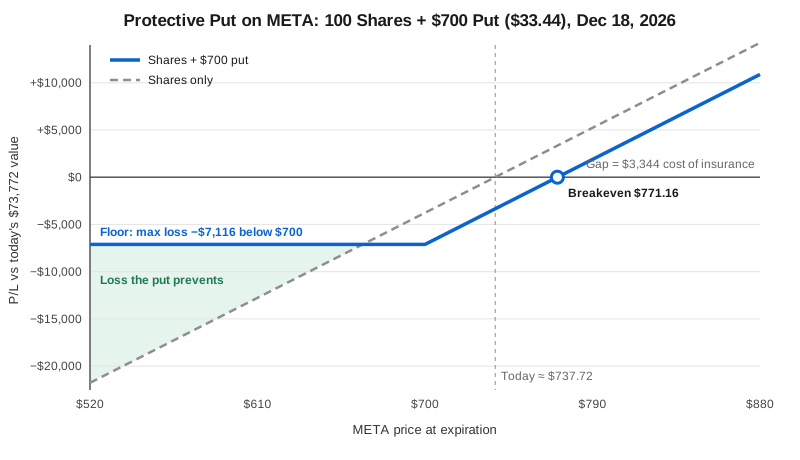
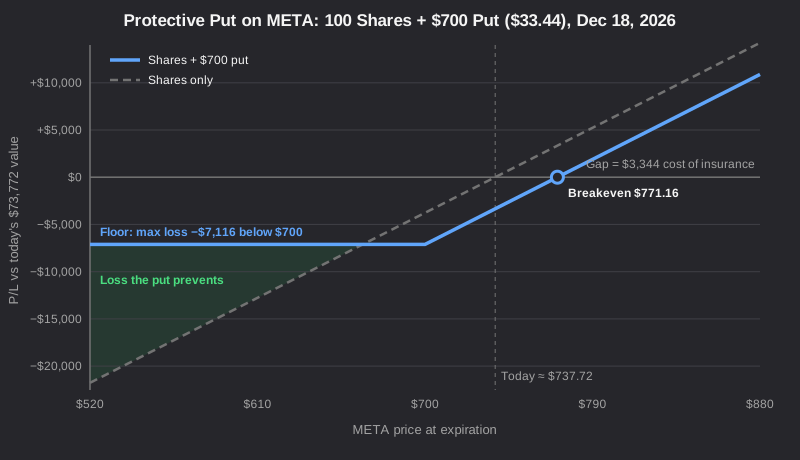
Scenarios at expiration (P/L vs today’s $73,772)
| META on Dec 18 | Shares only | Shares + $700 put | Put’s effect |
|---|---|---|---|
| $520 (March low) | -$21,772 | -$7,116 | Saves $14,656 |
| $600 | -$13,772 | -$7,116 | Saves $6,656 |
| $666.56 | -$7,116 | -$7,116 | Break-even point of the hedge |
| $700 | -$3,772 | -$7,116 | Costs $3,344 |
| $737.72 | $0 | -$3,344 | Costs $3,344 |
| $771.16 | +$3,344 | $0 | Costs $3,344 |
| $850 | +$11,228 | +$7,884 | Costs $3,344 |
Try it yourself: load this META setup in the calculator and move the strike or expiry to see the payoff and Greeks change.
The pattern is simple. Above $666.56 at expiration, the put costs you exactly its premium. Below it, the put saves you everything past the floor.
Choosing the Strike: Premium vs Deductible
Higher strikes mean better protection and higher cost. Lower strikes are cheap but only kick in after a real drawdown. Same 100 META shares, same December 18 expiration:
| Strike | Distance from $737.72 | Premium | % of position | Annualized cost | Max loss incl. premium |
|---|---|---|---|---|---|
| $740 | +0.3% (at the money) | $4,914 | 6.7% | ~28% | $4,686 |
| $720 | -2.4% | $4,074 | 5.5% | ~23% | $5,846 |
| $700 | -5.1% | $3,344 | 4.5% | ~19% | $7,116 |
| $680 | -7.8% | $2,717 | 3.7% | ~16% | $8,489 |
| $650 | -11.9% | $1,951 | 2.6% | ~11% | $10,723 |
| $600 | -18.7% | $1,059 | 1.4% | ~6% | $14,831 |
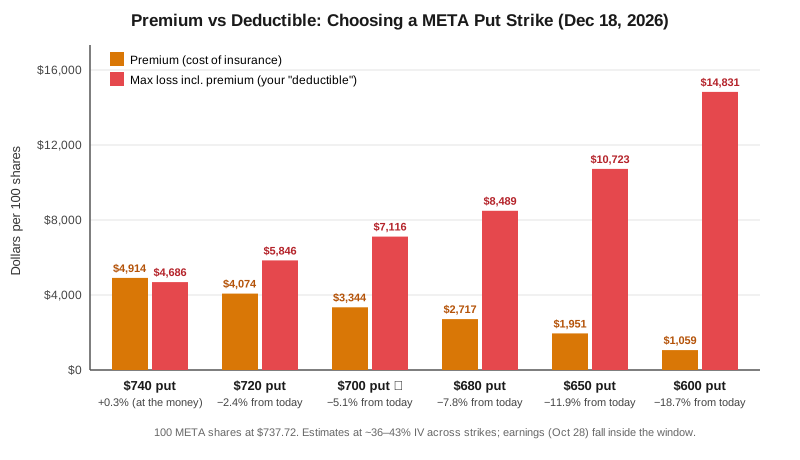
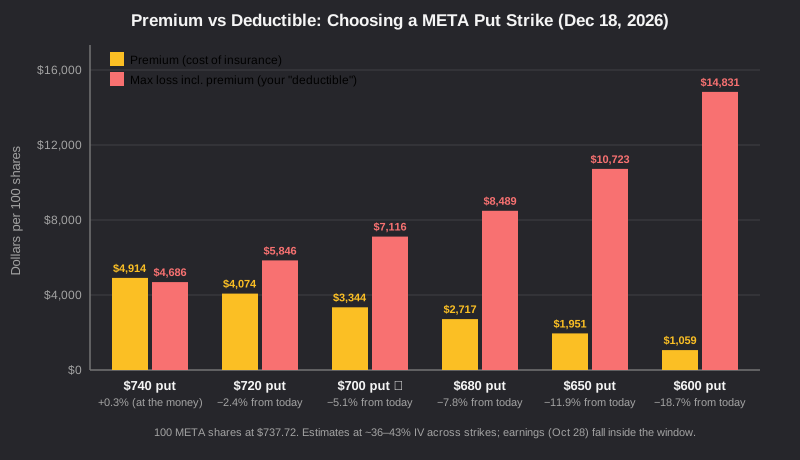
Notice the $740 row: the premium ($4,914) is larger than the maximum loss ($4,686). At-the-money protection is so expensive that you’re essentially pre-paying your worst case.
In practice, I look for the strike where the max loss is a number I can live with and the premium doesn’t eat most of my expected gain. For a volatile stock into earnings, a strike 5-8% out of the money is often the sweet spot.
What Happens Before Expiration
The floor is guaranteed only at expiration. Along the way, the put still carries time value, so protection is softer than the payoff diagram suggests.
| Path | META | Days left | Shares P/L | Put P/L | Total |
|---|---|---|---|---|---|
| Flat into earnings | ~$738 | 51 | $0 | -$830 | -$830 |
| Earnings miss | -12% (~$649) | 50 | -$8,852 | +$2,896 | -$5,956 |
| Earnings beat | +8% (~$797) | 50 | +$5,898 | -$2,993 | +$2,905 |
| Flat into December | ~$738 | 27 | $0 | -$2,287 | -$2,287 |
On a 12% earnings drop, the put cuts the loss by about a third right away - not all of it. It keeps gaining as the stock stays down and expiration nears. Traders who need the full floor immediately use a closer strike or a shorter expiration.
The flat-market rows show the real cost of insurance: time decay eats the put about $25 a day at the start.
Protective Put vs Other Ways to Protect a Gain
| Method | Upfront cost | Downside protection | Upside | Main drawback |
|---|---|---|---|---|
| Sell the shares | Taxes due now | Complete | None | Triggers a (possibly short-term) taxable gain |
| Stop-loss order at $700 | Free | Only if price trades there | Full | Gaps straight through the stop on earnings |
| Protective put ($700) | $3,344 | Full below $666.56 | Full, minus premium | Expensive, time decay |
| Put spread (buy $700 / sell $600) | ~$2,285 | Only from $700 to $600 | Full, minus premium | No protection below $600 |
| Collar (buy $700 put / sell $820 call) | ~$1,145 | Full below the floor | Capped at $820 | Gives away the big upside |
The stop-loss row deserves attention. A stop order at $700 turns into a market order once hit. If META gaps from $740 to $640 after earnings, you sell near $640. A put pays out at $700 regardless of the gap. That’s exactly what you’re paying for.
If the premium feels too high, a collar lets the short call fund most of the put - at the price of capping your upside.
How to Manage a Protective Put
- Time it around real risk. Buy protection before known events (earnings, product launches, macro data) rather than holding it permanently.
- Monetize after a drop. If META falls sharply, consider selling the inflated put and buying a new, lower one - you lock in hedge gains and reset the floor.
- Roll up after a rally. If META climbs to $820, sell the $700 put for what’s left and buy a higher strike to protect the new gain.
- Don’t insure forever. At ~19% a year, permanent protection would erase most of a stock’s expected return.
- Check taxes before buying. In the U.S., buying a put on shares held one year or less can reset the holding period used for long-term capital gains. Shares bought in March 2026 would fall under this rule. Talk to a tax advisor.
Before placing the trade, check your worst case in the calculator.
Risks and Limitations of the Protective Put
- Expensive. Protecting volatile stocks through earnings can cost 4-7% for three months.
- Time decay. The put loses value every day the stock doesn’t fall.
- Soft floor before expiration. Mid-trade protection depends on remaining time value and volatility.
- Volatility crush. After earnings, falling IV can shrink the put’s value even if the stock slips a little.
- Drag on returns. Repeated hedging steadily reduces long-term performance.
- Tax complications. Holding-period rules can affect short-term positions.
When a Protective Put Makes Sense (and When It Doesn’t)
It fits when you have a large unrealized gain you don’t want to sell, a concentrated position, or a specific event you’re worried about. It’s also useful when selling would trigger a big tax bill or you’re bullish long term but nervous short term.
It doesn’t fit as a permanent overlay, on small positions where the cost outweighs the benefit, or when IV is already extreme after a crash. In those cases, reducing position size or using a collar is often smarter.
Frequently Asked Questions (FAQ)
What is a protective put?
It’s buying a put option on a stock you already own. The put sets a minimum sale price for your shares until expiration.
How much does a protective put cost?
It depends on the strike, time, and volatility. On volatile stocks around earnings, three-month protection 5% below the price often costs 4-5% of the position.
Is a protective put better than a stop-loss?
It costs money, but it protects you even if the stock gaps below your level overnight. A stop-loss is free but can execute far below your target in a gap.
What happens to the put if the stock goes up?
The put loses value and may expire worthless. You keep the stock’s gains, minus the premium you paid.
Related strategies
- Alternative: Long Put
- Key terms: Option Premium, Strike Price, Extrinsic Value (Time Value)
Risk Disclaimer: This article is for educational and informational purposes only and does not constitute investment, financial, legal, or tax advice. Buying put options involves the risk of losing the entire premium paid, and protective puts reduce returns if the stock does not decline. Options trading is not suitable for all investors. Prices, premiums, implied volatility, and scenarios in the examples are illustrative estimates and may differ from live market data. Earnings dates may change. Tax rules vary by jurisdiction and individual circumstances. Past performance does not guarantee future results. Before trading options, read Characteristics and Risks of Standardized Options (OCC) and consult licensed financial and tax professionals.