
Cash-Secured Put: How It Works, Formulas, and a Real GOOGL Example
By OptionsPriceCalculator Team · Published October 7, 2026 · Updated October 7, 2026
A cash-secured put means selling a put option while keeping enough cash in your account to buy 100 shares at the strike price if you’re assigned. You collect the premium up front. If the stock stays above the strike, you keep the premium and your cash is released. If it falls below the strike, you buy the shares at the strike, with the premium lowering your effective purchase price.
In plain words, it’s getting paid to place a buy order below the market. You name your price - and the market pays you to wait. This strategy is part of our options strategies guide. To test it with your own numbers, open the cash-secured put calculator.
How a Cash-Secured Put Works
The mechanics are simple. The discipline is what makes it work.
- Short put. You take on the obligation to buy 100 shares at the strike before expiration.
- Cash reserve. Strike x 100 sits in your account as collateral. No margin, no leverage.
- Premium. Paid to you immediately, and yours to keep no matter what happens.
- Two outcomes. Either the put expires worthless and you keep the premium, or you’re assigned and buy the stock at a discount to today’s price.
Why it’s different from a naked put
The payoff is identical. The risk profile isn’t. A naked put uses margin, so a sharp drop can trigger margin calls and forced exits. A cash-secured put is fully funded: the worst case is simply owning a stock you already wanted, at a price you chose in advance.
That’s why most brokers allow cash-secured puts at a lower options approval level, and many allow them in retirement accounts.
Cash-Secured Put Formulas: Breakeven, Max Profit, Max Loss
| Metric | Formula | What it tells you |
|---|---|---|
| Cash required | Strike x 100 | Collateral held until expiration or closing |
| Effective purchase price | Strike - Premium | Your real cost if assigned |
| Breakeven at expiration | Strike - Premium | Below this, the position loses money |
| Maximum profit | Premium x 100 | Stock anywhere above the strike |
| Maximum loss | (Strike - Premium) x 100 | Stock goes to zero |
| Return on cash | Premium / (Strike - Premium) | Yield for the period, before interest on cash |
| Annualized return | Return x 365 / Days to expiration | For comparing strikes and expirations |
One detail many guides skip: the cash you set aside can often earn interest while it waits - in a money market fund or T-bills, depending on your broker. That’s a second, smaller income stream on top of the premium.
How It Works in Practice: A Cash-Secured Put on Alphabet (GOOGL)
Here’s a setup based on late September 2026 conditions. Alphabet Class A trades near $357.15, about 12% below its 52-week high of $408.61. The stock sits at a P/E around 18 - cheap for a mega-cap tech name - and the next earnings report is expected around October 28, 2026.
Suppose you’d happily own GOOGL, but closer to $330 than $357. Instead of placing a limit order and waiting, you sell a put:
- Sell: GOOGL $340 put, expiring November 6, 2026 (45 days) -> $7.93
- Premium received: $793
- Cash reserved: $340 x 100 = $34,000
- Delta: about -0.30 (roughly a one-in-three chance of assignment)
Note: the premium is an illustrative Black-Scholes estimate at ~32% implied volatility, which is elevated because earnings fall inside the trade window. Check live quotes before trading.
The math for this trade
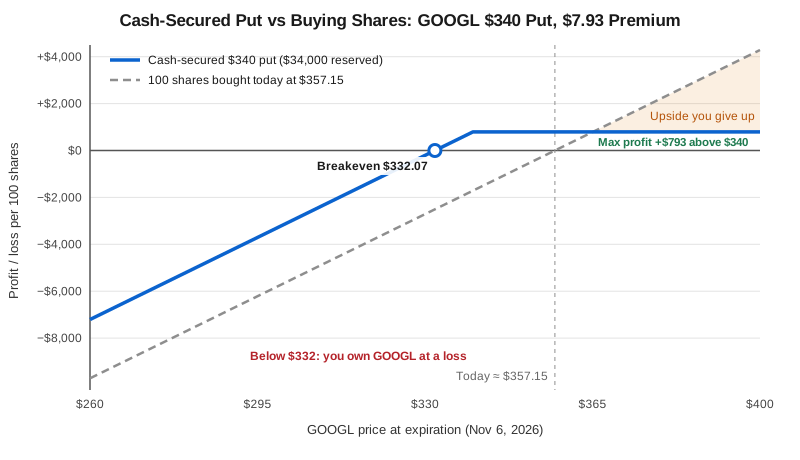
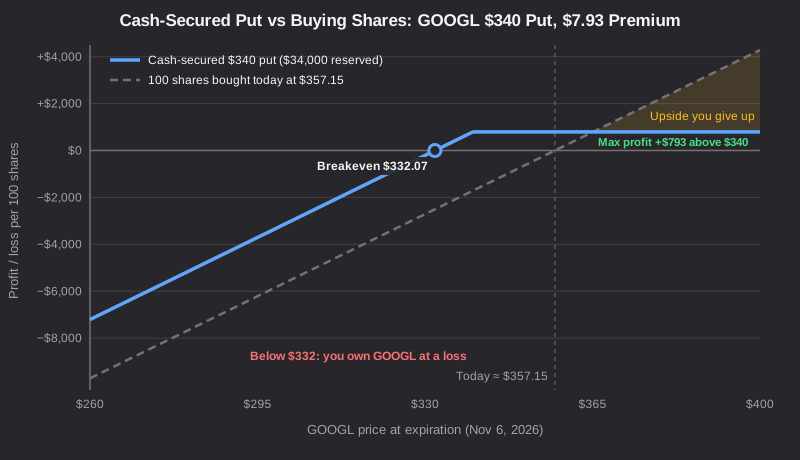
- Effective purchase price if assigned: $340 - $7.93 = $332.07 (7.0% below today’s price)
- Breakeven: $332.07
- Maximum profit: $793 (GOOGL above $340 on Nov 6)
- Return on cash: $7.93 / $332.07 ≈ 2.4% in 45 days - about 19.4% annualized
- Bonus: at ~3.85%, the $34,000 reserve could earn roughly $160 in interest over the same period
- Maximum loss: $332.07 x 100 = $33,207 (GOOGL to zero)
Scenarios at expiration
| GOOGL on Nov 6 | Cash-secured put | 100 shares bought today | What happens |
|---|---|---|---|
| $400 | +$793 | +$4,285 | Put expires; you miss the rally |
| $365.08 | +$793 | +$793 | Both results equal |
| $357 | +$793 | -$15 | Put expires; you keep the premium |
| $340 | +$793 | -$1,715 | Put expires (or you’re assigned at $340) |
| $332.07 | $0 | -$2,508 | Assigned; you own 100 shares at an effective $332.07 |
| $300 | -$3,207 | -$5,715 | Assigned; paper loss on the shares |
| $235.84 (52-week low) | -$9,623 | -$12,131 | Assigned; deep drawdown |
Try it yourself: load this GOOGL setup in the calculator and move the strike or expiry to see the payoff change.
The table shows the trade-off clearly. Below $365, the put beats buying shares outright. Above $365, the shareholder wins - and the gap grows with every dollar of rally.
Cash-Secured Put vs Limit Order vs Buying Now
| Criteria | Buy 100 shares now | Limit buy order at $340 | Cash-secured $340 put |
|---|---|---|---|
| Cost basis | $357.15 | $340.00 | $332.07 (if assigned) |
| Paid while waiting | Dividends only | Nothing | $793 premium |
| If GOOGL rallies | Full upside | No fill, no gain | Keep $793, miss the rest |
| If GOOGL dips to $345 | Paper loss | No fill | Keep $793, no shares |
| If GOOGL crashes | Full loss from $357 | Filled at $340 | Assigned at $340, cushioned by premium |
| Can be filled early | - | Yes, immediately | Usually only near or at expiration |
A limit order fills the moment the price touches $340. A put usually gets assigned only at expiration, if GOOGL finishes below the strike. So a quick dip to $335 that bounces back to $350 would fill the limit order - but leave the put seller with just the premium and no shares.
In practice, treat the cash-secured put as a patient limit order. You get paid to wait, but you give up control over the exact timing.
Picking the Strike: Income vs Odds of Owning the Stock
Closer strikes pay more and get assigned more often. Farther strikes pay less but give a deeper discount if assigned. Same GOOGL, same November 6 expiration:
| Strike | Premium | Buy price if assigned | Discount to $357.15 | Annualized yield | Est. odds of assignment |
|---|---|---|---|---|---|
| $355 | $13.20 | $341.80 | -4.3% | ~31% | ~48% |
| $350 | $11.21 | $338.79 | -5.1% | ~27% | ~43% |
| $340 | $7.93 | $332.07 | -7.0% | ~19% | ~34% |
| $330 | $5.46 | $324.54 | -9.1% | ~14% | ~25% |
| $320 | $3.66 | $316.34 | -11.4% | ~9% | ~19% |
| $310 | $2.39 | $307.61 | -13.9% | ~6% | ~13% |
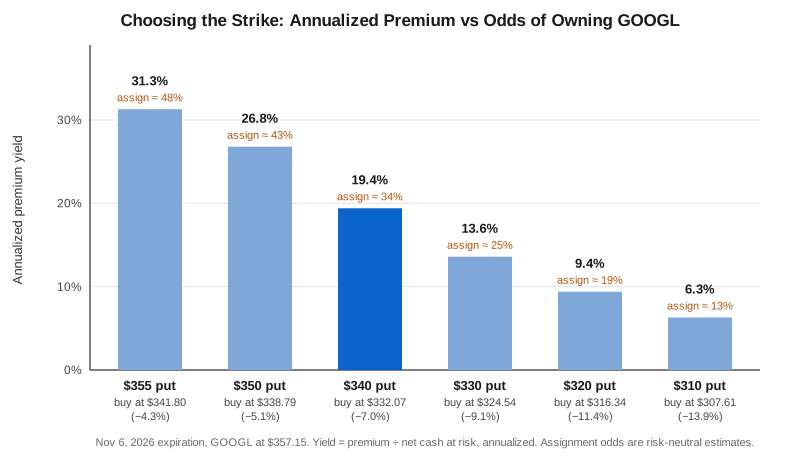
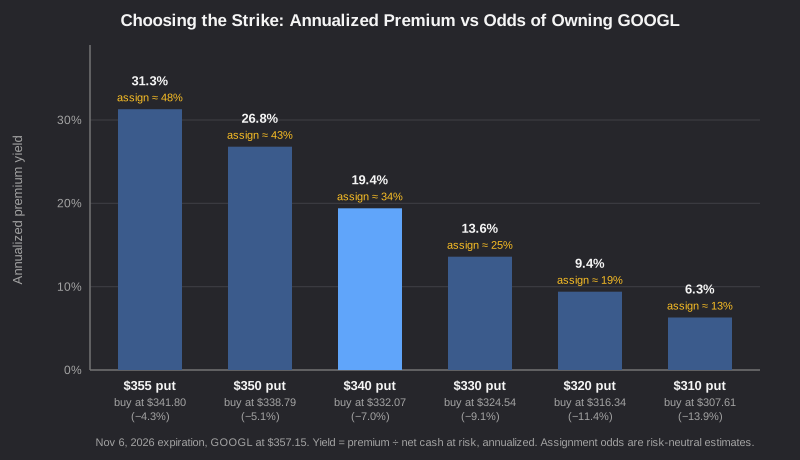
Those 20-30% annualized yields look tempting. Don’t mistake them for a savings rate. They exist because this window includes an earnings report - the market is paying you to absorb a possible 10% drop.
Pick the strike based on the price you’d genuinely be happy to pay, not on the yield. If owning GOOGL at $341.80 would bother you, the $355 put isn’t your trade, no matter how rich it looks.
What Happens During the Trade
| Path | GOOGL | Days left | Put value | P/L |
|---|---|---|---|---|
| Quiet market | ~$357 | 21 | $3.49 | +$444 |
| Steady rally | +5% (~$375) | 31 | $1.70 | +$623 |
| Pre-earnings dip | -5% (~$339) | 10 | $8.39 | -$46 |
| Earnings beat | +8% (~$386) | 8 | ~$0 | +$793 |
| Earnings miss | -10% (~$321) | 8 | $19.06 | -$1,113 |
A quiet market delivers more than half the premium within three weeks. Many traders close at 50-70% of max profit and redeploy the cash into a new put, rather than waiting for the last few dollars.
The earnings-miss row is the real cost of the trade. A 10% gap down leaves you facing assignment at $340 with GOOGL at $321. That’s not a disaster if you wanted the stock - it’s simply a worse entry than you hoped for.
After Assignment: The Wheel
If you get assigned, you own 100 GOOGL shares at an effective $332.07. Many investors then sell covered calls above that cost basis, collecting more premium while they hold. If the shares get called away, they go back to selling puts.
This cycle - put, assignment, covered call, repeat - is known as the wheel. It works best on high-quality stocks you’d be comfortable holding through a long drawdown. It works worst on stocks you only “sort of” like.
Before placing the trade, check your worst case in the calculator.
Risks and Limitations of the Cash-Secured Put
- Full downside exposure. Below the breakeven, you lose almost as much as a shareholder. The premium is a cushion, not a hedge.
- Capped upside. If the stock rallies hard, you earn only the premium and miss the move.
- Gap risk. Earnings or news can send the stock far below your strike overnight.
- Capital lock-up. $34,000 stays tied up for 45 days and can’t be used elsewhere.
- Early assignment. Deep ITM puts can be assigned before expiration.
- Opportunity cost. If the stock never comes down, you may never own it - and watch it climb without you.
- Taxes. Premiums and assignments have specific tax treatment. Check the rules in your jurisdiction.
When a Cash-Secured Put Makes Sense (and When It Doesn’t)
It fits when you want to buy a quality stock at a lower price, have the cash ready, and would be comfortable holding the shares through a drawdown. Elevated implied volatility makes the premium even more attractive.
It doesn’t fit on stocks you don’t want to own, when you need the cash soon, or when you’re strongly bullish and afraid of missing a rally. In that last case, buying the shares - or a call - fits the view better.
Frequently Asked Questions (FAQ)
What is a cash-secured put?
It’s selling a put option while holding enough cash to buy 100 shares at the strike price. You collect a premium and may end up buying the stock at a discount.
Can you lose money on a cash-secured put?
Yes. If the stock falls below the strike minus the premium, you lose money on the shares you’re assigned - almost as much as if you’d bought them outright.
Is a cash-secured put better than a limit order?
It pays you a premium while you wait, but it usually fills only at expiration and caps your gain if the stock rallies. A limit order fills immediately but pays nothing.
What happens if my cash-secured put is assigned?
You buy 100 shares at the strike price using the reserved cash. Your effective cost is the strike minus the premium you received.
Related strategies
- Key terms: Put Option, Strike Price, Option Premium, Break-even Price, Assignment
Risk Disclaimer: This article is for educational and informational purposes only and does not constitute investment, financial, legal, or tax advice. Selling put options involves substantial risk, including the obligation to buy shares at a price above the market and losses up to the full strike value if the stock falls to zero. Options trading is not suitable for all investors. Prices, premiums, implied volatility, probabilities, and interest rates in the examples are illustrative estimates and may differ from live market data. Earnings dates may change. Past performance does not guarantee future results. Before trading options, read Characteristics and Risks of Standardized Options (OCC) and consult licensed financial and tax professionals.