
Short Put: How It Works, Formulas, and a Real JPM Example
By OptionsPriceCalculator Team · Published October 13, 2026 · Updated October 13, 2026
A short put (often called a naked put) means selling a put option on margin without setting aside the full cash to buy the shares. You collect the premium up front and keep it if the stock stays above the strike until expiration. If the stock falls below the strike, you’re obligated to buy 100 shares at the strike price. The maximum profit is the premium; the maximum loss is the strike minus the premium, times 100, if the stock goes to zero.
The payoff is identical to a cash-secured put. The difference is leverage: a naked put ties up only a fraction of the capital, which magnifies both returns and losses. This strategy is part of our options strategies guide. To test it with your own numbers, open the short put calculator.
How a Short Put Works
- Sell 1 put. You receive the premium immediately.
- Margin, not full cash. Your broker holds only a portion of the strike value as collateral.
- Obligation. If assigned, you must buy 100 shares at the strike - and have enough buying power to do it.
- Margin grows as the stock falls. The requirement rises just when you’re losing money.
Short put vs cash-secured put in one sentence
A cash-secured put is the same trade with a 1:1 cash reserve. A naked put is the same trade with leverage - and leverage is what turns a normal drawdown into a margin call.
Short Put Formulas: Breakeven, Max Profit, Max Loss
| Metric | Formula | What it tells you |
|---|---|---|
| Premium received | Put premium x 100 | Your maximum profit |
| Breakeven | Strike - Premium | Below this price, you lose money |
| Maximum profit | Premium x 100 | Stock at or above the strike at expiration |
| Maximum loss | (Strike - Premium) x 100 | Stock goes to zero |
| P/L at expiration | [Premium - max(0, K - S)] x 100 | S = stock price, K = strike |
| Reg T margin (typical) | Premium + max(20% x S - OTM amount, 10% x K) | Rises as the stock falls |
| Return on margin | Premium / Margin | Looks high because the capital base is small |
The last line is where most traders get fooled. A high return on margin is simply a smaller denominator - the dollar risk hasn’t changed.
How It Works in Practice: A Short Put on JPMorgan (JPM)
Here’s a setup based on late September 2026 conditions. JPMorgan trades near $352.09, a few percent below its 52-week high of $366.50, with a P/E around 15. The bank just raised its quarterly dividend 10% to $1.65 (ex-date October 6), and third-quarter results are due in mid-October. It’s not a quiet backdrop: the Fed raised rates on September 16, and regulators have started asking big banks about their exposure to large trading firms after turmoil at a hedge fund.
The thesis: JPM stays above $330 through November, and you’d be comfortable owning it there anyway. Instead of reserving $33,000 in cash, you sell the put on margin:
- Sell: JPM $330 put, expiring November 20, 2026 (59 days) -> $5.73
- Premium received: $573
- Estimated margin: about $5,400 (Reg T)
- For comparison, cash-secured collateral: $33,000 ($32,427 net of premium)
- Put delta: about -0.25 (the position acts like owning ~25 shares)
Note: the premium is an illustrative Black-Scholes estimate at ~26% implied volatility, adjusted for the October dividend. Earnings fall inside the window. Margin rules vary by broker. Check live quotes before trading.
The math for this trade
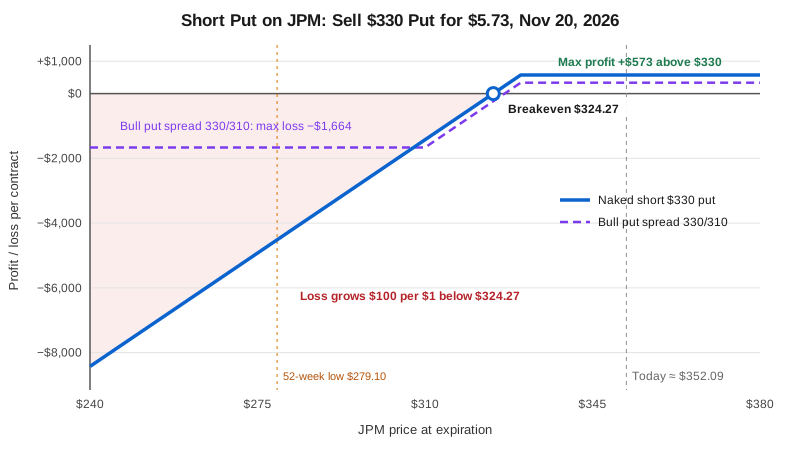
- Breakeven: $330 - $5.73 = $324.27 (-7.9% from $352.09)
- Maximum profit: $573
- Return on margin: about 10.6% in 59 days (~65% annualized)
- Return on cash-secured basis: about 1.8% (~11% annualized)
- Estimated odds of expiring above the strike: roughly 72%
- Maximum loss: $324.27 x 100 = $32,427 (JPM to zero)
Scenarios at expiration
| JPM on Nov 20 | Profit / loss | Return on ~$5,400 margin | Return on ~$32,400 cash |
|---|---|---|---|
| $360 | +$573 | +10.6% | +1.8% |
| $352.09 | +$573 | +10.6% | +1.8% |
| $330 | +$573 | +10.6% | +1.8% |
| $324.27 | $0 | 0% | 0% |
| $310 | -$1,427 | -26% | -4.4% |
| $300 | -$2,427 | -45% | -7.5% |
| $279.10 (52-week low) | -$4,517 | -84% | -14% |
| $250 | -$7,427 | -138% | -23% |
Try it yourself: load this JPM setup in the calculator and move the strike or expiry to see the payoff and margin change.
Same trade, same dollars. On a cash basis, a drop to the 52-week low is a painful but survivable 14% drawdown. On a margin basis, it wipes out 84% of the capital you posted.
What Happens Before Expiration: The Margin Squeeze
Margin requirements don’t stay fixed. As JPM falls, the broker asks for more collateral - while your losses grow at the same time.
| Path | JPM | Days left | P/L | Margin required |
|---|---|---|---|---|
| Rally | +5% (~$369.70) | 45 | +$463 | ~$3,530 |
| Quiet market | ~$352 | 30 | +$319 | ~$5,090 |
| Dip | -5% (~$334.50) | 45 | -$546 | ~$7,360 |
| Selloff | -10% (~$316.90) | 52 | -$1,805 | ~$8,720 |
| Bank panic | -20% (~$281.70) | 45 | -$4,554 | ~$10,760 |
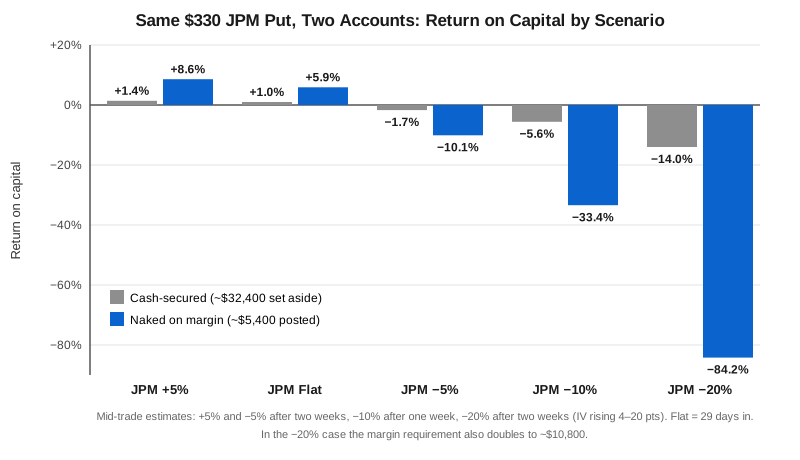
In the bank-panic row, the account needs to absorb a $4,554 loss and post roughly double the original margin. Traders who sized positions to their margin - not their cash - are the ones who get forced out at the bottom.
The hidden leverage in numbers
With $33,000 in an account, Reg T margin would technically let you sell about six of these puts. That’s control over $198,000 of JPM stock. A 20% drop would cost around $27,000 - most of the account - on a trade that “only” had a 72% win rate per contract.
That’s why we size naked puts as if they were cash-secured, even when the broker allows more.
Choosing the Strike
Same JPM, same November 20 expiration:
| Strike | Premium | Breakeven | Est. odds above strike | Margin | Return on margin | Return on cash |
|---|---|---|---|---|---|---|
| $345 | $1,027 | $334.73 | ~57% | ~$7,360 | 14.0% | 3.1% |
| $340 | $852 | $331.48 | ~62% | ~$6,690 | 12.7% | 2.6% |
| $330 | $573 | $324.27 | ~72% | ~$5,410 | 10.6% | 1.8% |
| $320 | $374 | $316.26 | ~80% | ~$4,210 | 8.9% | 1.2% |
| $310 | $237 | $307.63 | ~86% | ~$3,340 | 7.1% | 0.8% |
| $300 | $146 | $298.54 | ~91% | ~$3,150 | 4.6% | 0.5% |
Two rules I follow. First, pick a strike where owning the stock would feel fine - assignment is not a failure, it’s one of the planned outcomes. Second, judge the trade by return on cash, not on margin. That column tells you what you’re actually earning for the risk.
Assignment, Dividends, and Earnings
- Assignment. If JPM closes below $330 on November 20, you’ll buy 100 shares for $33,000. On margin, that means borrowing - and paying interest - unless you close the put first.
- Early assignment. Deep in-the-money puts can be assigned before expiration, especially when interest rates are high.
- Dividends. The October 6 ex-date slightly lowers JPM’s price and raises put values. It’s already baked into the premium.
- Earnings. The mid-October report sits inside this trade. A bad quarter can gap the stock through your breakeven overnight.
Short Put vs Its Alternatives
| Strategy | Credit | Max loss | Capital needed | Best for |
|---|---|---|---|---|
| Naked short $330 put | $573 | $32,427 | ~$5,400 margin | Experienced traders with spare buying power |
| Cash-secured $330 put | $573 | $32,427 | $32,427 cash | Investors who want to own JPM |
| Bull put spread 330/310 | $336 | $1,664 | $1,664 | Defined-risk bullish view |
| Covered call on JPM ($330) | Similar payoff | Similar | Shares owned | Existing JPM holders |
By put-call parity, a short put behaves almost exactly like a covered call at the same strike - both profit up to a cap and carry nearly full downside below it.
Buying a $310 put for about $2.37 turns the naked put into a bull put spread. You give up roughly 40% of the premium, and your worst case drops from $32,427 to $1,664. For most accounts, that’s the rational version of this trade.
How to Manage a Short Put
- Size as if cash-secured. Use margin for flexibility, not to multiply position count.
- Take profits early. Buying back at 50-75% of max profit removes most of the tail risk.
- Set a loss limit. Many sellers exit if the put doubles or the stock closes below the strike.
- Roll down and out. If the stock drops but your thesis holds, roll to a lower strike and later expiration - ideally for a net credit.
- Know your assignment plan. Decide in advance whether you’ll take the shares or close before expiration.
Before placing the trade, check your worst case in the calculator.
The Greeks at entry
- Theta: about +$8.91 per day. Time decay works for you.
- Delta: about +0.25. You’re effectively long 25 shares - more as the stock falls.
- Vega: about -$44 per IV point. Rising fear hurts, often at the same time as falling prices.
- Gamma: negative. Losses accelerate as the stock approaches and breaks the strike.
Risks and Limitations of the Short Put
- Large downside. Nearly the same as owning the stock below the breakeven.
- Leverage. Small margin makes losses look - and feel - much bigger.
- Margin calls. Requirements rise as the stock falls, forcing exits at bad prices.
- Gap risk. Earnings or sector shocks can push the stock far below your stop overnight.
- Capped upside. Your gain is limited to the premium, no matter how much the stock rallies.
- Assignment financing. Being assigned on margin means borrowing to hold the shares.
When a Short Put Makes Sense (and When It Doesn’t)
It fits for experienced traders who want to own a quality stock at a lower price, understand margin mechanics, and keep enough cash in reserve to handle assignment or a doubled margin requirement.
It doesn’t fit when you’re using margin to sell more contracts than you could afford to be assigned, on speculative stocks, or ahead of binary events you can’t absorb. In those cases, a cash-secured put or a bull put spread is the better tool.
Frequently Asked Questions (FAQ)
What is a short put?
It’s selling a put option, usually on margin, without holding enough cash to buy the shares. You collect a premium and must buy the stock at the strike if assigned.
What is the difference between a short put and a cash-secured put?
The payoff is the same. A cash-secured put holds the full strike value in cash; a naked short put uses margin, which adds leverage and the risk of margin calls.
What is the maximum loss on a short put?
The strike minus the premium, times 100, if the stock falls to zero.
How can I reduce the risk of a short put?
Buy a lower-strike put with the same expiration. That creates a bull put spread with a fixed maximum loss.
Related strategies
- Opposite: Long Put
- Twin: Short Call
- Key terms: Option Premium, Assignment, Margin Requirements, Theta (Time Decay)
Risk Disclaimer: This article is for educational and informational purposes only and does not constitute investment, financial, legal, or tax advice. Selling put options on margin involves substantial risk, including losses that can exceed the capital deposited, margin calls, and the obligation to buy shares at prices above the market. Options trading is not suitable for all investors. Prices, premiums, implied volatility, probabilities, margin requirements, and scenarios in the examples are illustrative estimates and may differ from live market data and broker rules. Earnings and dividend dates may change. Past performance does not guarantee future results. Before trading options, read Characteristics and Risks of Standardized Options (OCC) and consult a licensed financial professional.