
Covered Call: How It Works, Formulas, and a Real KO Example
By OptionsPriceCalculator Team · Published October 16, 2026 · Updated October 16, 2026
A covered call means owning 100 shares of a stock and selling one call option against them. You collect the premium up front and keep it no matter what. If the stock stays below the strike, you keep both the shares and the premium. If it rises above the strike, your shares are sold at the strike price - you lock in a gain, but give up any upside beyond it.
In plain words, you rent out the upside of stock you already own. The rent is the premium, and the price is a ceiling on your profit. This strategy is part of our options strategies guide. To test it with your own numbers, open the covered call calculator.
How a Covered Call Works
- Long 100 shares. The “cover.” Because you own the stock, you can always deliver it if the call is exercised.
- Short 1 call. Usually out of the money, above the current price.
- Premium. Paid to you immediately. Extra income on top of any dividends.
- Two outcomes. The call expires worthless and you sell another one, or the shares get called away at the strike.
What you’re really trading
You swap an uncertain upside for a certain payment today. That’s a good deal when you expect the stock to drift sideways or rise slowly. It’s a bad deal when the stock rips higher - and it does nothing to protect you from a real drop.
A covered call is an income strategy, not a hedge. That distinction causes more beginner losses than any formula.
Covered Call Formulas: Breakeven, Max Profit, Max Loss
| Metric | Formula | What it tells you |
|---|---|---|
| Premium income | Call premium x 100 | Yours to keep in every scenario |
| Breakeven | Stock cost - Premium - Dividends received | Below this, the position loses money |
| Maximum profit | (Strike - Stock cost + Premium + Dividends) x 100 | Stock at or above the strike at expiration |
| Maximum loss | (Stock cost - Premium - Dividends) x 100 | Stock goes to zero |
| Downside cushion | Premium / Stock price | How far the stock can fall before you lose money |
| Static return | (Premium + Dividends) / Stock price | Income if the stock doesn’t move |
The downside cushion is usually small - often 1-3%. Keep that number in mind whenever someone describes covered calls as “safe.”
How It Works in Practice: A Covered Call on Coca-Cola (KO)
Here’s a setup based on late September 2026 conditions. Coca-Cola trades near $87.25, a little under its 52-week high of $90.92. The company raised its 2026 outlook in July and pays a $0.53 quarterly dividend ($2.12 a year, about 2.4%). The last ex-dividend date was September 15; the next one is expected around early December, though it hasn’t been announced yet.
KO is a classic covered-call stock: steady, low volatility (beta around 0.34), and not likely to double in two months. You own 100 shares and want more income:
- Own: 100 KO shares at $87.25 ($8,725)
- Sell: KO $92 call, expiring December 18, 2026 (87 days) -> $1.16
- Premium received: $116
- Expected dividend inside the window: $53 (if you still hold the shares on the ex-date)
- Delta of the call: about 0.28 (roughly a one-in-four chance of being called away)
Note: the premium is an illustrative Black-Scholes estimate at ~16.5% implied volatility, adjusted for the expected December dividend. Check live quotes before trading.
The math for this trade
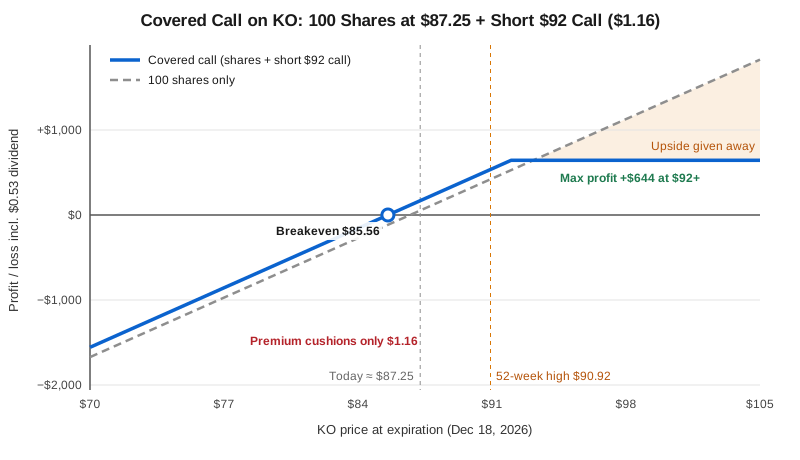
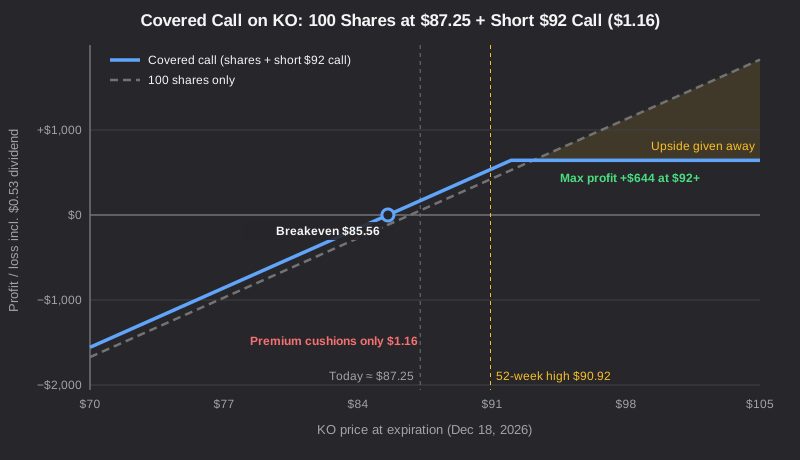
- Breakeven: $87.25 - $1.16 - $0.53 = $85.56
- Maximum profit: ($92 - $87.25 + $1.16 + $0.53) x 100 = $644 (+7.4%)
- Static return if KO doesn’t move: $1.69 / $87.25 ~= 1.9% in 87 days (~8% annualized)
- Downside cushion from the premium alone: just 1.3%
- Maximum loss: $85.56 x 100 = $8,556 (KO to zero)
Scenarios at expiration (dividend included where received)
| KO on Dec 18 | Covered call | Shares only | What happened |
|---|---|---|---|
| $105 | +$591 | +$1,828 | Likely called away early, before the ex-date (no dividend) |
| $95 | +$644 | +$828 | Called away at $92 |
| $92 | +$644 | +$528 | Max profit reached |
| $90 | +$444 | +$328 | Call expires; keep shares |
| $87.25 | +$169 | +$53 | Flat stock: premium + dividend |
| $85.56 | $0 | -$116 | Breakeven |
| $80 | -$556 | -$672 | Premium barely helps |
| $65.35 (52-week low) | -$2,021 | -$2,137 | A real drawdown |
Read the bottom rows carefully. At $65, the covered call saves you just $116 compared with holding the shares. The premium is a cushion, not a shield.
Choosing the Strike: Income vs Upside
Closer strikes pay more but cap your gains sooner. Farther strikes leave more room to run but pay less. Same KO position, same December 18 expiration:
| Strike | Premium | Downside cushion | Max profit (incl. dividend) | Est. odds of being called | Annualized premium yield |
|---|---|---|---|---|---|
| $88 | $2.70 | 3.1% | $398 | ~46% | ~13% |
| $90 | $1.83 | 2.1% | $511 | ~35% | ~9% |
| $92 | $1.16 | 1.3% | $644 | ~25% | ~6% |
| $95 | $0.51 | 0.6% | $879 | ~13% | ~2% |
Here’s the trade-off in one line: the $88 call pays more than twice as much as the $92 call, but it caps your total gain at $398 instead of $644.
In practice, pick the strike where you’d be genuinely happy to sell. For KO, $92 sits just above the 52-week high - if the stock breaks out through that level in eight weeks, that’s a 7% gain worth taking.
The Dividend Trap: Early Assignment Before the Ex-Date
This is where covered calls on dividend stocks get tricky. American-style calls can be exercised any day. A call owner will often exercise the day before the ex-dividend date to capture the dividend - if the call’s remaining extrinsic value is smaller than the dividend.
For our $92 call, with about 18 days left before expiration on the day before a December ex-date:
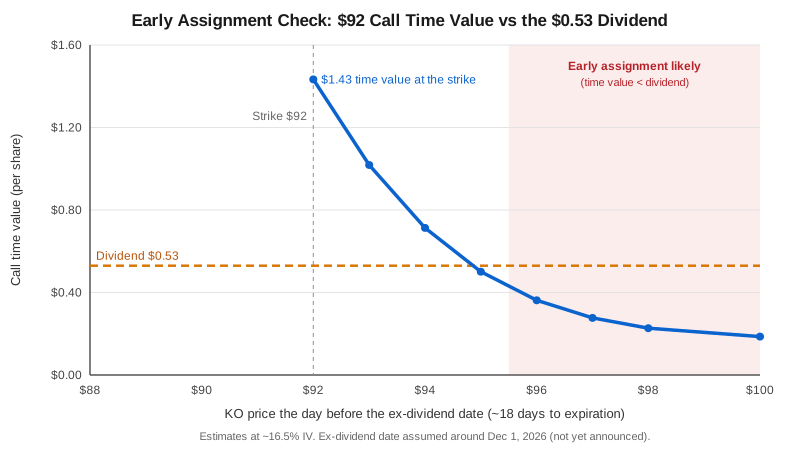
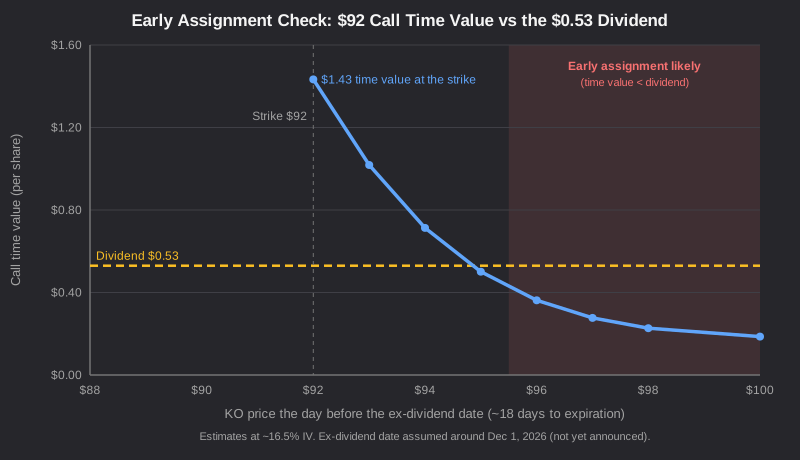
- KO at $92: time value ~= $1.43 -> exercising would be irrational; you keep the shares and the dividend
- KO at $94: time value ~= $0.71 -> still above the dividend
- KO at $96+: time value falls to roughly $0.36 -> early assignment becomes likely
If you’re assigned early, you sell at $92, miss the $53 dividend, and your max profit drops to $591. Not a disaster - but a surprise for many first-timers.
The fix is simple: check the call’s remaining time value a few days before the ex-date. If it’s below the dividend, either accept assignment or roll the call to a later expiration and higher strike.
Managing a Covered Call
- Close early at 50-80% of max premium. If the call drops from $1.16 to $0.25, buying it back frees you to sell a new one.
- Roll when tested. If KO rallies toward $92, buy back the call and sell a later-dated, higher-strike call - ideally for a net credit.
- Don’t write calls below your cost basis unless you’re happy to lock in a loss if called.
- Watch earnings dates. A covered call collects more premium into earnings, but the stock can gap either way.
- Mind taxes. In the U.S., selling deep in-the-money calls can affect the holding period for qualified dividends. Check with a tax advisor.
The Greeks of the position
- Delta: about +72 shares. You still own most of the stock’s direction.
- Theta: about +$1.59 per day. Small, but steady on a low-volatility stock.
- Vega: about -$14 per IV point. Falling volatility helps; spikes hurt a little.
Covered Call vs Cash-Secured Put
These two strategies are close cousins. By put-call parity, a covered call and a cash-secured put at the same strike have nearly the same payoff.
| Criteria | Covered call | Cash-secured put |
|---|---|---|
| Starting point | You own the shares | You hold cash |
| Dividends | Yes, while you hold | No |
| Goal | Extra income, sell at a target price | Buy at a lower price |
| Main risk | Stock falls; upside capped | Stock falls after assignment |
| Natural next step | If called away -> sell puts | If assigned -> sell calls |
Put them together and you get the wheel: sell cash-secured puts until assigned, then sell covered calls until the shares are called away, and repeat. See our guide to the cash-secured put for the first half of that cycle.
Risks and Limitations of the Covered Call
- Full downside exposure. The premium offsets only a small part of a real decline.
- Capped upside. A takeover bid, blowout earnings, or sector rally can run far past your strike.
- Early assignment. Especially before ex-dividend dates, you can lose the shares and the dividend.
- Opportunity cost. Over long bull markets, systematic covered-call writing often trails simple buy-and-hold.
- Taxes. Assignment triggers a sale of your shares, which can create capital gains, and some calls affect dividend treatment.
- Low premiums on stable stocks. On names like KO, the income is modest - don’t stretch strikes lower just to chase yield.
When a Covered Call Makes Sense (and When It Doesn’t)
It fits when you own a stock you’d be happy to sell at a higher price, you expect sideways or slow upward movement, and you value steady income over maximum upside.
It doesn’t fit when you’re strongly bullish, when the stock could jump on a catalyst you care about, or when you’re counting on the premium to protect you from a decline. For protection, a protective put or a collar fits far better.
Frequently Asked Questions (FAQ)
What is a covered call?
It’s owning 100 shares of a stock and selling one call option against them. You earn a premium and agree to sell your shares at the strike if the stock rises above it.
Can you lose money on a covered call?
Yes. If the stock falls below your cost minus the premium and dividends, you lose money - almost as much as holding the shares alone.
What happens if my covered call is exercised?
Your 100 shares are sold at the strike price. You keep the premium and any dividends already received.
When can a covered call be assigned early?
Most often the day before an ex-dividend date, when the call’s time value is lower than the upcoming dividend.
Related strategies
- Alternative: Short Call
- Key terms: Assignment, Rolling (Up / Down / Out), Dividend Risk, Extrinsic Value (Time Value)
Risk Disclaimer: This article is for educational and informational purposes only and does not constitute investment, financial, legal, or tax advice. Covered calls do not protect against significant declines in the underlying stock and limit upside potential. Options trading is not suitable for all investors. Prices, premiums, implied volatility, probabilities, and dividend dates in the examples are illustrative estimates and may differ from live market data and company announcements. Past performance does not guarantee future results. Before trading options, read Characteristics and Risks of Standardized Options (OCC) and consult licensed financial and tax professionals.