
Short Call: How It Works, Formulas, and a Real WMT Example
By OptionsPriceCalculator Team · Published October 10, 2026 · Updated October 10, 2026
A short call (also called a naked call or uncovered call) means selling a call option without owning the underlying shares. You collect the premium up front and keep it if the stock stays below the strike until expiration. If the stock rallies above the strike, you’re obligated to deliver 100 shares at the strike price - shares you don’t own. The maximum profit is the premium, and the maximum loss is unlimited.
It’s the most asymmetric trade in the options playbook: small, frequent wins against rare but open-ended losses. This strategy is part of our options strategies guide. To test it with your own numbers, open the short call calculator.
How a Short Call Works
- Sell 1 call. You receive the premium immediately.
- No stock owned. That’s what makes it “naked” - nothing offsets a rally.
- Obligation. If assigned, you must sell 100 shares at the strike, which leaves you short the stock.
- Margin. Brokers require collateral, and the requirement grows as the stock rises.
What you’re betting on
You’re betting the stock won’t rise above the strike plus the premium before expiration. Falling, flat, or slowly rising prices all work. Only a strong rally hurts - and that rally has no ceiling.
Most brokers reserve naked call approval for their highest options level. That’s a signal worth taking seriously.
Short Call Formulas: Breakeven, Max Profit, Max Loss
| Metric | Formula | What it tells you |
|---|---|---|
| Premium received | Call premium x 100 | Your maximum profit |
| Breakeven | Strike + Premium | Above this price, you lose money |
| Maximum profit | Premium x 100 | Stock at or below the strike at expiration |
| Maximum loss | Unlimited | Grows $100 per $1 above breakeven |
| P/L at expiration | [Premium - max(0, S - K)] x 100 | S = stock price, K = strike |
| Reg T margin (typical) | Premium + max(20% x S - OTM amount, 10% x S) | Rises as the stock rises |
The profit column is a fixed number. The loss column isn’t a number at all. That mismatch is the entire story of this strategy.
How It Works in Practice: A Short Call on Walmart (WMT)
Here’s a setup based on late September 2026 conditions. Walmart closed near $106.79, well below its 52-week high of $135.16. After the August report, the stock fell 9.2% in a day despite beating on EPS, as investors worried about margin quality. Since then it has traded in a tight $102-$109 range. Beta is low (around 0.58), and the next earnings report is expected on November 19.
The thesis: Walmart keeps chopping in its range for the next six weeks, with little reason to break out before earnings. You sell a call above the range - and pick an expiration that ends before the next report:
- Sell: WMT $115 call, expiring November 6, 2026 (45 days) -> $0.87
- Premium received: $87
- Estimated margin: about $1,400 (Reg T)
- Call delta: about 0.20 (the position acts like being short ~20 shares)
Note: the premium is an illustrative Black-Scholes estimate at ~22% implied volatility. Margin rules vary by broker. Check live quotes before trading.
The math for this trade
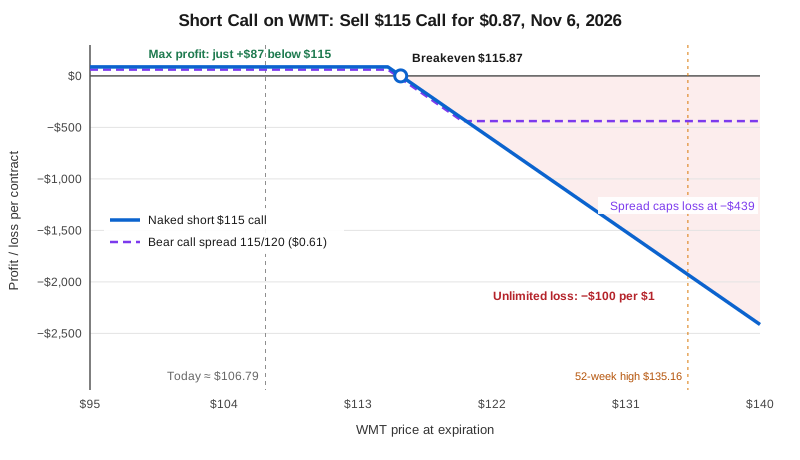
- Breakeven: $115 + $0.87 = $115.87 (+8.5% from $106.79)
- Maximum profit: $87
- Return on margin: about 6.2% in 45 days
- Estimated odds of expiring below breakeven: roughly 82%
- Maximum loss: unlimited
Scenarios at expiration
| WMT on Nov 6 | Profit / loss | What happened |
|---|---|---|
| $100 | +$87 | Call expires worthless |
| $106.79 | +$87 | Flat stock: keep the premium |
| $115 | +$87 | Still at the strike: keep the premium |
| $115.87 | $0 | Breakeven |
| $120 | -$413 | Loss is 4.7x the premium |
| $125 | -$913 | Back to August levels |
| $135.16 (52-week high) | -$1,929 | Loss is 22x the premium |
| $150 | -$3,413 | Takeover-style move |
Look at the last row. One surprise can wipe out the premium from 39 successful trades like this one.
What Happens Before Expiration
| Path | WMT | Days left | Call value | P/L |
|---|---|---|---|---|
| Quiet market | ~$106.79 | 21 | $0.24 | +$63 |
| Mild dip | -5% (~$101.40) | 31 | $0.12 | +$75 |
| Grinding rally | +5% (~$112.10) | 31 | $1.94 | -$107 |
| Sharp rally | +10% (~$117.50) | 38 | $5.69 | -$482 |
| Surge | +15% (~$122.80) | 38 | $9.86 | -$899 |
A quiet market delivers about 70% of the premium in three weeks. Many sellers buy back at 50-75% of max profit rather than holding for the last few dollars.
The rally rows show the core problem: a 10% move - something Walmart has done in a single day - turns an $87 trade into a $482 loss before expiration.
The Win-Rate Trap: Picking the Strike
Farther strikes win more often. They also pay so little that one bad month erases many good ones. Same WMT, same November 6 expiration, with a 10% gap higher and 30 days left:
| Strike | Premium | Breakeven | Est. win odds | Margin | Return on margin | Loss on +10% gap | Loss / premium |
|---|---|---|---|---|---|---|---|
| $108 | $309 | $111.09 | ~55% | ~$2,320 | 13.3% | -$734 | 2.4x |
| $110 | $225 | $112.25 | ~64% | ~$2,040 | 11.0% | -$652 | 2.9x |
| $112 | $158 | $113.58 | ~72% | ~$1,770 | 8.9% | -$565 | 3.6x |
| $115 | $87 | $115.87 | ~82% | ~$1,400 | 6.2% | -$432 | 5.0x |
| $118 | $44 | $118.44 | ~90% | ~$1,110 | 3.9% | -$308 | 7.0x |
| $120 | $26 | $120.26 | ~94% | ~$1,090 | 2.4% | -$236 | 9.1x |
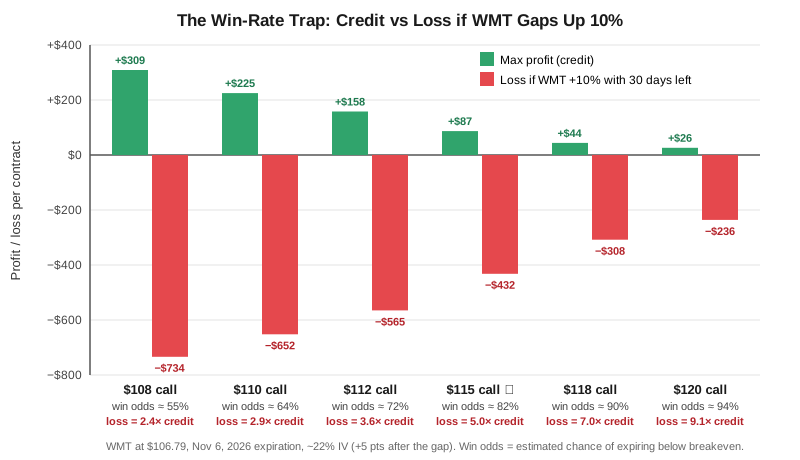
A 94% win rate sounds wonderful until you notice that a single loss costs nine trades’ worth of premium. There’s no strike that makes the math “safe.” There’s only a trade-off between how often you’re wrong and how much it costs when you are.
Why the Expiration Date Matters as Much as the Strike
We chose November 6 on purpose. The next monthly expiration, November 20, would include Walmart’s November 19 earnings report. The last report moved the stock 9.2% in a day - downward that time, but nothing guarantees the next one won’t go the other way.
Selling a naked call across earnings means betting against a binary event with a capped reward. The extra premium rarely justifies it. In practice, we either close before the report or don’t open the trade at all.
Dividend risk matters too. If a short call ends up deep in the money before an ex-dividend date, it may be assigned early, leaving you short the stock and owing the dividend. Walmart’s next ex-date is December 11 - after this trade expires.
Safer Alternatives to a Naked Call
| Strategy | Credit / cost | Max profit | Max loss | Margin | Best for |
|---|---|---|---|---|---|
| Naked short $115 call | +$87 | $87 | Unlimited | ~$1,400 | Experienced sellers with strict rules |
| Bear call spread 115/120 | +$61 | $61 | $439 | $439 | Same view, defined risk |
| Covered call ($115) | +$87 | Premium + stock gain to $115 | Stock downside | Shares owned | Investors already holding WMT |
| Long $105 put | Pays premium | Large | Premium paid | Premium | Truly bearish views |
Buying a $120 call for $0.26 turns the naked call into a bear call spread. You give up $26 of the $87 premium - about 30% of your income - and in exchange your worst case drops from “unlimited” to $439. For most traders, that’s the best insurance deal in this entire article.
How to Manage a Short Call
- Sell above real resistance. Here, $115 sits above the post-earnings trading range of roughly $102-$109.
- Avoid event risk. Close before earnings, investor days, or pending M&A news.
- Take profits early. Buying back at 50-75% of max profit removes the tail risk for pennies.
- Set a hard stop. Many sellers exit if the call doubles or triples in price, or if the stock closes above the strike.
- Size for the gap. Assume a 15-20% overnight move and make sure your account survives it.
- Watch margin. A rally raises the requirement at exactly the wrong time.
The Greeks at entry
- Theta: about +$2.76 per day. Time decay is your only friend here.
- Delta: about -0.20. You’re effectively short 20 shares at first - and more as the stock rises.
- Vega: about -$10 per IV point. Rising volatility hurts.
- Gamma: negative. Losses accelerate as the stock approaches and passes the strike.
Risks and Limitations of the Short Call
- Unlimited loss. There’s no ceiling on how high a stock can go.
- Gap risk. Earnings, takeover bids, and short squeezes can blow through any stop overnight.
- Margin calls. Requirements rise with the stock, forcing exits at the worst prices.
- Early assignment. You can be assigned before expiration and end up short shares, including owing dividends.
- Poor risk/reward. High win rates hide losses that are many times larger than typical gains.
- Approval barriers. Most brokers require top-tier options approval and substantial account equity.
When a Short Call Makes Sense (and When It Doesn’t)
It fits for experienced traders with large, well-capitalized accounts, on low-volatility stocks trading below clear resistance, over windows with no scheduled catalysts - and with strict exit rules.
It doesn’t fit on momentum stocks, heavily shorted names, stocks with takeover potential, or across earnings. It also doesn’t fit most retail accounts. In nearly every case, a bear call spread offers the same view with a defined worst case.
Frequently Asked Questions (FAQ)
What is a short call?
It’s selling a call option without owning the stock. You collect a premium and must deliver shares at the strike if the stock rises above it.
What is the maximum loss on a short call?
Unlimited. Losses grow $100 for every $1 the stock rises above the breakeven.
What is the difference between a naked call and a covered call?
A covered call is backed by 100 shares you own, so a rally only caps your gains. A naked call has no shares behind it, so a rally creates unlimited losses.
How can I limit the risk of a short call?
Buy a higher-strike call with the same expiration. That turns it into a bear call spread with a fixed maximum loss.
Related strategies
- Opposite: Long Call
- Twin: Short Put
- Alternative: Covered Call
- Used in: Bull Call Spread
- Key terms: Option Premium, Assignment, Early Exercise, Margin Requirements, Delta, Theta (Time Decay), Vega, Gamma, Implied Volatility (IV), Dividend Risk
Risk Disclaimer: This article is for educational and informational purposes only and does not constitute investment, financial, legal, or tax advice. Selling uncovered call options involves unlimited risk, including losses that can far exceed the premium received and the funds in your account. Options trading is not suitable for all investors. Prices, premiums, implied volatility, probabilities, margin requirements, and scenarios in the examples are illustrative estimates and may differ from live market data and broker rules. Earnings and dividend dates may change. Past performance does not guarantee future results. Before trading options, read Characteristics and Risks of Standardized Options (OCC) and consult a licensed financial professional.